
ARPANET's First Message: 'LO' and the Birth of the Internet, 1969
The seminal moment in digital communication history began not with a perfect transmission, but with an incomplete one: the two letters 'LO' sent over the ARPANET. This fragmented message, delivered in 1969, marked the first successful host-to-host communication over a wide-area packet-switched network.
The digital world, interconnected and immediate, began not with a grand declaration, but with a simple, incomplete two-letter message: "LO". This transmission, sent over the fledgling ARPANET on October 29, 1969, marked the first successful host-to-host communication on a wide-area, packet-switched network, laying the groundwork for what would become the Internet.
The Vision for Connected Computing
Before the ARPANET, computers were largely isolated behemoths. Universities and research institutions often owned powerful but expensive mainframe computers, which operated independently, processing tasks in batches or serving a handful of local users through dedicated terminals. The idea of sharing these valuable resources – processors, specialized software, and data storage – across geographically dispersed locations was a compelling challenge for the Advanced Research Projects Agency (ARPA) of the U.S. Department of Defense.
Visionaries like J.C.R. Licklider at ARPA had articulated the concept of an "Intergalactic Network" in the early 1960s, envisioning a future where computers could communicate seamlessly. Simultaneously, independent research by figures such as Paul Baran at RAND Corporation and Donald Davies at the National Physical Laboratory in the UK converged on the concept of "packet switching." This innovative approach broke down data into small, manageable blocks, or "packets," which could be routed independently through a network and reassembled at their destination. This offered a more robust and efficient alternative to traditional circuit switching, where a dedicated, continuous connection had to be established for the duration of a communication.
Under the leadership of Robert Taylor, ARPA funded a project to build this experimental network. Bolt Beranek and Newman (BBN) won the contract to develop the Interface Message Processors (IMPs) – specialized mini-computers designed to handle the packet-switching tasks, acting as gateways for the host computers at each site. Leonard Kleinrock, a professor at the University of California, Los Angeles (UCLA), had already published foundational work on queuing theory applicable to packet-switched networks, making his lab a natural choice for the first node.
The 'LO' Moment
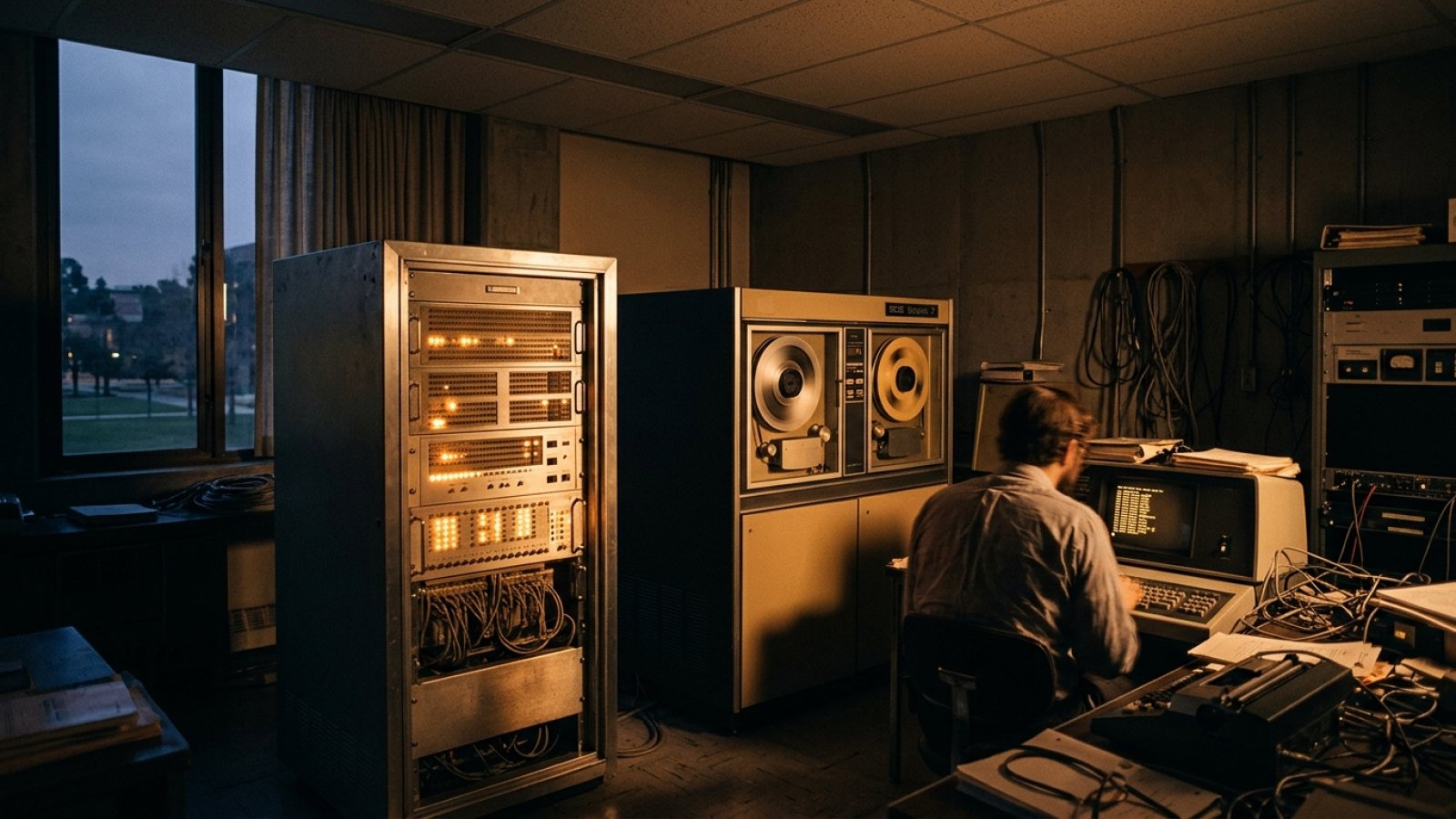
The scene was the Network Measurement Center at UCLA, housed in Room 3420 of Boelter Hall. On one side stood a powerful SDS Sigma 7 host computer, and connected to it, the refrigerator-sized BBN-built IMP. Its twin, the second ARPANET node, resided at the Stanford Research Institute (SRI), connected to an SDS 940 host computer.
On the evening of October 29, 1969, graduate student Charley Kline sat at the UCLA console. His task was to establish a remote connection, or "login," to the SRI computer. The plan was simple: Kline would type the command "LOGIN," and Bill Duvall at SRI would confirm its reception over a telephone line. As Kline typed the letter 'L', it traveled from the SDS Sigma 7, through the UCLA IMP, across the 50-kilobit-per-second dedicated telephone circuit, into the SRI IMP, and finally to the SRI SDS 940. Duvall confirmed its arrival. Kline then typed 'O', and Duvall again confirmed. But as Kline proceeded to type 'G', the system at SRI crashed.
The full "LOGIN" command was not successfully transmitted that night. Yet, the transmission of "LO" proved the fundamental concept: two disparate computers, miles apart, could communicate directly over a packet-switched network. It was an imperfect, yet profound, demonstration of a paradigm shift. The immediate problem was clear: debugging the software and hardware to complete the login. The immediate solution was a continued effort, leading to a successful full login transmission just a few hours later, and then the establishment of the third node at UC Santa Barbara in November, and the fourth at the University of Utah in December of the same year.
From ARPANET to Internet
The initial ARPANET, with its four university nodes, grew steadily. It became a vital tool for researchers, enabling resource sharing, collaborative projects, and the rapid exchange of information. This network was not just about connecting machines; it was about connecting people and ideas. The development of email by Ray Tomlinson in 1971, allowing messages to be sent between users on different host computers, dramatically increased the utility and popularity of the network.
A crucial evolution came with the work of Vinton Cerf and Robert Kahn, who developed the Transmission Control Protocol/Internet Protocol (TCP/IP) in the 1970s. This new suite of protocols provided a robust, standardized way for diverse networks to interoperate, solving the challenge of connecting ARPANET to other packet-switched networks that were emerging. This concept of "internetworking" is what gave the "Internet" its name. The transition of ARPANET to TCP/IP on January 1, 1983, known as Flag Day, marked the true birth of the modern Internet as a network of networks.
The 'LO' message was a small, almost accidental, step. But it was the initial pulse that initiated a continuous, iterative process of development, refinement, and expansion that transformed computing from isolated machines into a global, interconnected nervous system. The problems of sharing resources, collaborating remotely, and exchanging data that ARPANET sought to solve are still fundamental drivers of digital innovation today, echoing the fragmented login of 1969 with every packet transmitted across the globe.
