The Intel 4004: A Single Chip Reshapes Computation
In 1971, Intel released the 4004, the first commercially available microprocessor. This tiny silicon device integrated the core functions of a computer onto a single chip, fundamentally altering the trajectory of electronics.
Before 1971, the architecture of electronic computation relied on either bulky assemblies of discrete components or specialized, fixed-function integrated circuits, each performing a narrow set of tasks. Building a complex electronic device, such as a calculator or a data terminal, required dozens or even hundreds of these individual chips, each wired together on large circuit boards. This approach was costly, consumed significant power, and severely limited the size and flexibility of what could be built.
The Drive for Integration
The imperative for a more integrated, flexible solution became acutely apparent in the late 1960s. Japanese calculator manufacturer Busicom approached Intel in 1969 with a design for a new line of high-performance desktop calculators. Their original specification called for 12 custom integrated circuits, a number that Intel's Ted Hoff recognized as economically and practically inefficient. Hoff envisioned a more universal, programmable solution: a single chip that could perform many different functions depending on the instructions it received, rather than being hard-wired for one specific task. This concept was not merely a reduction in parts; it was a paradigm shift from fixed logic to programmable logic, centralizing the processing power.
While Hoff laid the architectural groundwork, and Stanley Mazor contributed to the instruction set, the monumental task of transforming this conceptual architecture into a physical silicon device fell largely to Federico Faggin. Joining Intel in 1970, Faggin led the design and implementation of the 4004, a project that culminated in 1971. Crucially, Faggin adapted and refined Intel's silicon gate technology, originally developed by Les Vadasz, to create self-aligned gates, a technique vital for achieving the density and performance required for such a complex chip. Busicom's engineer, Masatoshi Shima, also played a significant role, collaborating closely with Faggin on logic design and verification for the specific calculator application.
The Moment of the 4004
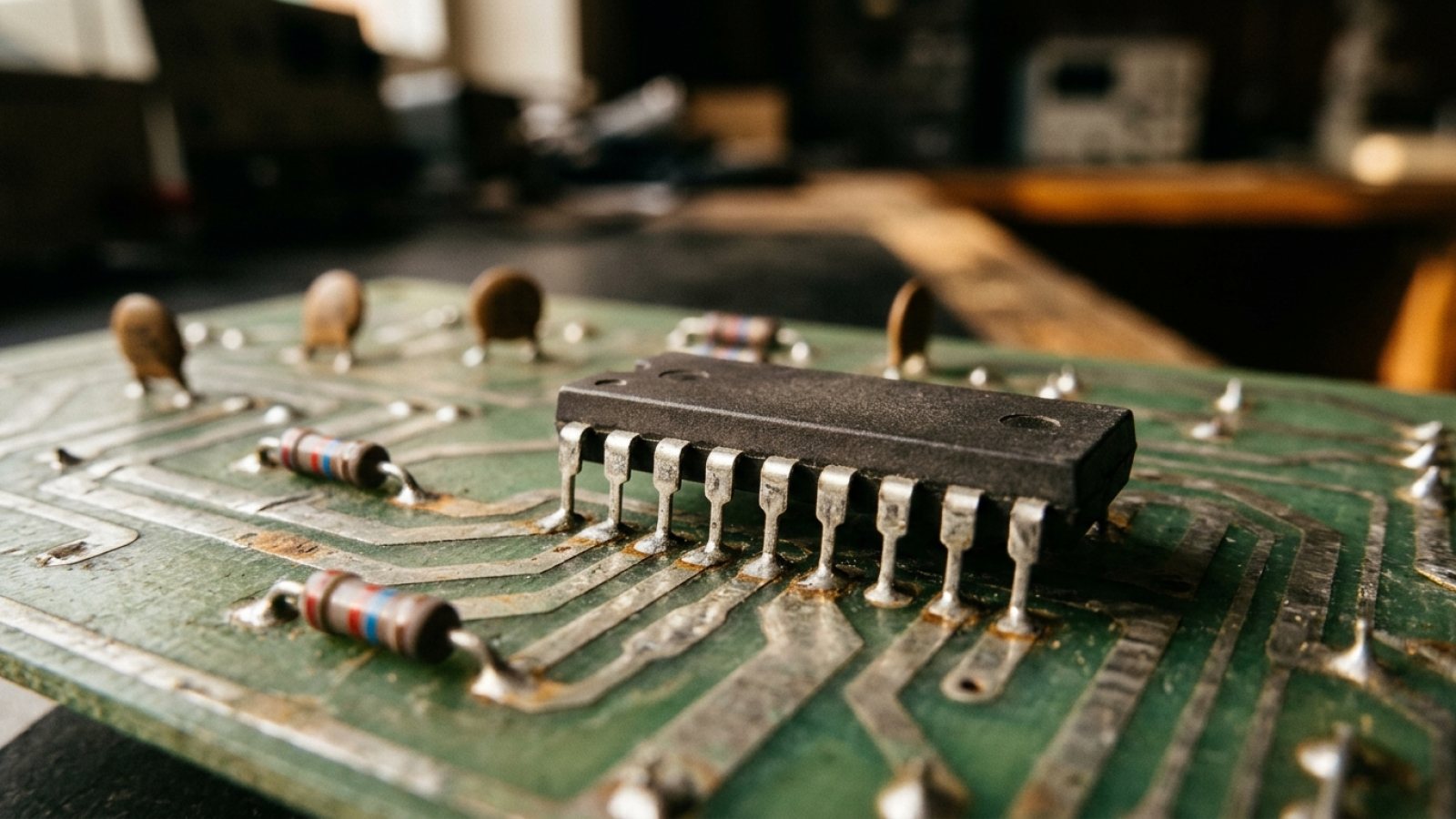
On November 15, 1971, Intel officially introduced the 4004 microprocessor. Housed in a 16-pin dual in-line package (DIP), this tiny chip measured approximately 1/8 inch wide by 3/16 inch long (3 mm by 4 mm). Despite its small size, it contained 2,300 transistors and could execute approximately 92,000 operations per second, with a clock speed of 740 kilohertz. The 4004 was a 4-bit CPU, meaning it processed data in 4-bit chunks (nybbles), a limitation suited for its initial calculator purpose but powerful enough to demonstrate the concept of a general-purpose processor on a chip.
Initially, Busicom had exclusive rights to the 4004, but Intel recognized the broader potential of a programmable processor. Intel negotiated to buy back the rights to the 4004 and the associated chipset (the 4001 ROM, 4002 RAM, and 4003 shift register) for $60,000, allowing them to market the chip to other customers. This decision proved to be one of the most significant in computing history, opening the door for the microprocessor to become a universally available building block for technology.
A New Era of Digital Design
The commercial availability of the Intel 4004 marked the true beginning of the microprocessor era. Its immediate impact was the simplification and miniaturization of electronic devices. Engineers no longer needed to design custom logic circuits for every function; instead, they could program a single, inexpensive chip to perform a variety of tasks. This dramatically reduced development time, manufacturing costs, and the physical footprint of electronic systems.
The 4004 quickly led to more powerful successors, such as the 8-bit Intel 8008 in 1972 and the widely influential Intel 8080 in 1974. These chips accelerated the development of early personal computers, embedded systems, and an array of programmable devices that had previously been impractical or impossible. The 4004 demonstrated that a complex central processing unit could indeed be integrated onto a single piece of silicon, a concept that fueled the exponential growth predicted by Moore's Law and fundamentally redefined the relationship between hardware and software. It laid the foundation for every digital device that followed, from supercomputers to smartphones, by proving that the intelligence of a machine could be distilled into a wafer-thin component.
