The Transistor: Bell Labs and the Dawn of Solid-State Electronics
In December 1947, a small device built at Bell Telephone Laboratories fundamentally changed the course of electronics. This invention, the transistor, replaced bulky vacuum tubes with a solid-state switch, laying the groundwork for every digital device that followed.
Before the transistor, the electronic world relied on the vacuum tube, a component that made radio, long-distance telephony, and early computers possible but carried significant limitations. These glass bulbs, often resembling incandescent light bulbs, functioned by controlling the flow of electrons through a vacuum. They were crucial to early circuits, acting as amplifiers and electronic switches.
However, vacuum tubes were fragile, consumed considerable power, generated much heat, and were relatively large. A single digital computer like the ENIAC required thousands of these tubes, occupying entire rooms and frequently failing due to burnt-out filaments. The quest for a smaller, more reliable, and more efficient alternative was a central challenge for electrical engineers in the mid-20th century, particularly at places like Bell Telephone Laboratories, which managed the vast and complex telephone network.
The Quest for a Solid-State Amplifier
Since the 1930s, physicists at Bell Labs had been investigating semiconductors, materials like silicon and germanium that conduct electricity under certain conditions, unlike insulators or full conductors. Scientists believed these materials might offer a way to control electric currents in a 'solid state,' without the need for a vacuum or heated filaments. William Shockley, a theoretical physicist at Bell Labs, began leading a research group in 1945 with the explicit goal of developing a solid-state amplifier. He theorized a field-effect device that could control current by applying an external electric field to a semiconductor surface.
Early experiments by Shockley and his team, including physicist John Bardeen and experimentalist Walter Brattain, did not immediately yield the predicted field-effect device. The effects they observed on the semiconductor surface were much smaller than expected. Bardeen, with his deep understanding of quantum mechanics and surface physics, proposed that electrons at the semiconductor's surface were trapping the electric field, preventing it from penetrating the material as deeply as Shockley's theory predicted.
A Spark of Germanium
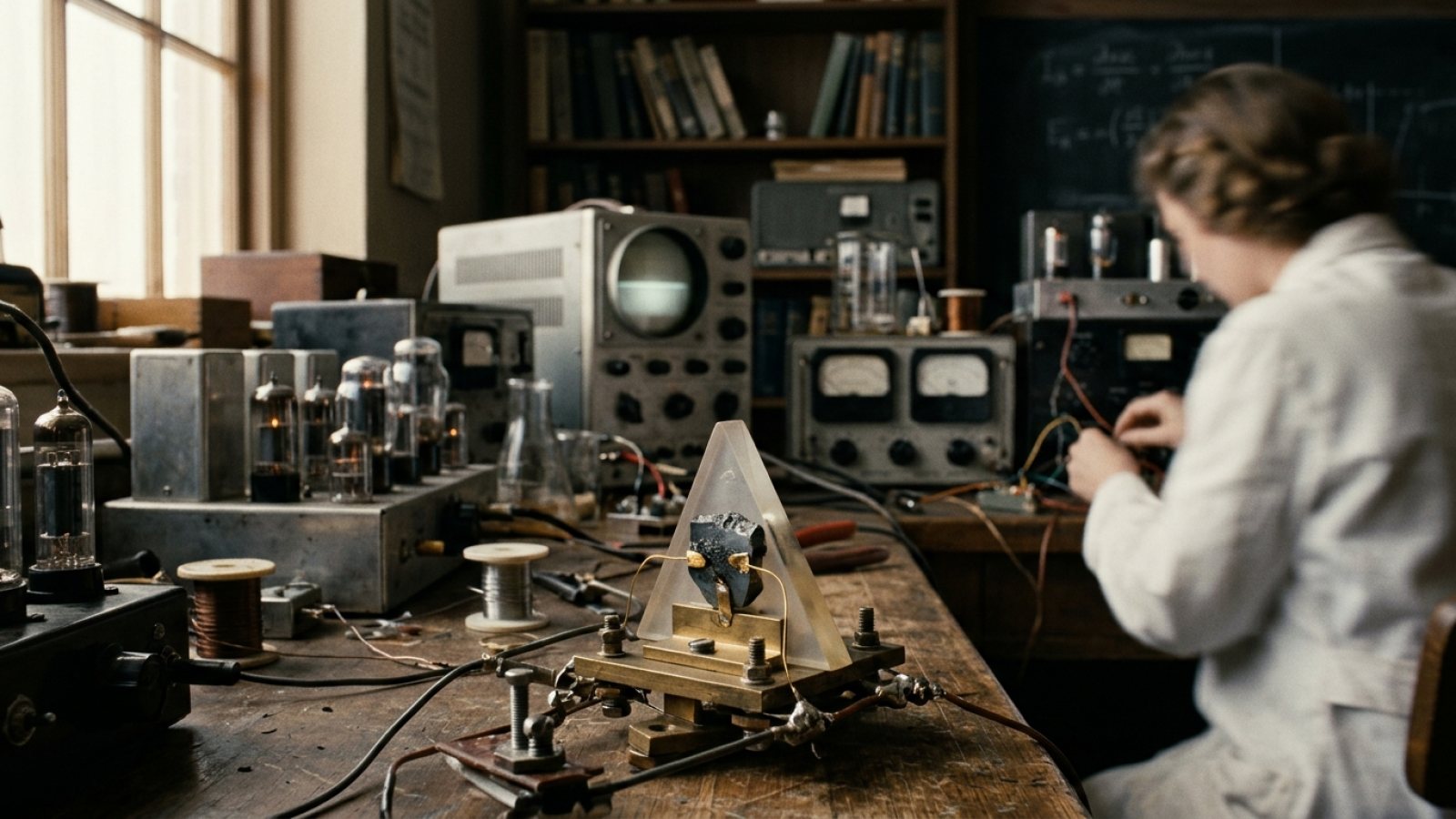
This insight led Bardeen and Brattain to explore new ways of interacting with the semiconductor surface. On December 16, 1947, in Laboratory 1C of Bell Labs in Murray Hill, New Jersey, Brattain was experimenting with a germanium crystal. He made electrical contact with the crystal using two closely spaced gold point contacts, pushed against the surface. When a small current was sent through one point (the 'emitter'), it modulated a much larger current flowing through the other point (the 'collector'), effectively amplifying the signal. The third terminal, the germanium itself, served as the 'base.'
This device, known as the point-contact transistor, demonstrated amplification and switching, performing the same basic function as a vacuum tube. Bell Labs formally announced the invention on December 23, 1947. Its physical form was rudimentary: a small triangular piece of plastic supporting two thin gold foils that made contact with a sliver of germanium. Despite its crude appearance, the implications were immediately clear: a solid-state device that could perform what a vacuum tube did, but smaller, cooler, and more robust.
From Point-Contact to Ubiquity
While the point-contact transistor was a profound scientific breakthrough, its practical application was limited by its mechanical complexity and difficulty of mass production. William Shockley, initially sidelined in the point-contact invention, soon went on to invent the junction transistor in 1950. This device, made by sandwiching layers of differently doped semiconductor materials, was far more reliable and easier to manufacture. It became the template for most transistors that followed and enabled the widespread adoption of transistor technology.
The transistor's invention, recognized with the Nobel Prize in Physics for Bardeen, Brattain, and Shockley in 1956, launched the solid-state electronics revolution. It rapidly led to the miniaturization of electronic devices, making portable radios, hearing aids, and eventually desktop calculators and early computers possible. The junction transistor's arrival paved the way for the integrated circuit (IC) in 1958, where multiple transistors and other components could be fabricated on a single piece of semiconductor material. This, in turn, led to the microchip and the microprocessor, forming the very foundation of every digital device we interact with today, from smartphones to supercomputers. The tiny switch invented in 1947 continues to define our interconnected world.
