Tim Berners-Lee's 1989 Proposal: The Memo That Became the World Wide Web
In 1989, facing a chaotic sea of information at CERN, Tim Berners-Lee penned a memo proposing a new way to link and share data. This seemingly modest document would lay the conceptual groundwork for the World Wide Web, transforming global communication forever.
At the European Organization for Nuclear Research (CERN) in 1989, a vast repository of scientific data, research papers, and technical documents resided across a disparate collection of computer systems. This labyrinth of information, managed by thousands of scientists and engineers from around the world, presented a formidable challenge: how to access, share, and link related content efficiently across varying hardware and software platforms. The problem was not a lack of information, but its isolation.
Before this moment, visionaries had conceived of interconnected information systems. Vannevar Bush, in his 1945 essay As We May Think, described the "Memex," a hypothetical device for individuals to store all their books, records, and communications, mechanizing their associative indexing for rapid retrieval. Decades later, Ted Nelson coined the term "hypertext" and initiated Project Xanadu, aiming to create a global network of linked documents with permanent two-way links and original attribution. While these ideas laid crucial theoretical groundwork, a practical, universally accessible implementation remained elusive. The existing internet, primarily an academic and military network, allowed for file transfer and email, but lacked an intuitive, seamless method for navigating interconnected documents across different servers without prior knowledge of their location or format.
A "Vague but Exciting" Proposal
It was into this environment that Tim Berners-Lee, a British software engineer working at CERN, introduced his proposal in March 1989. Titled Information Management: A Proposal, the memo outlined a system designed to address the "loss of information about complex evolving systems," suggesting a method for sharing information that could "be general and allow all sorts of relationships to be made." His supervisor, Mike Sendall, famously annotated the cover page with the phrase "Vague but exciting…".
Berners-Lee envisioned a global, decentralized information space where any piece of information could be linked to any other, regardless of its physical location or the machine storing it. His core insight was to combine existing technologies—the internet's global connectivity, hypertext's linking capabilities—with new protocols and a universal addressing scheme. He proposed a system where documents, identified by unique addresses (later Uniform Resource Identifiers, URIs), could be accessed by a client application (a browser) interacting with a server, all communicating via a simple, stateless protocol (the Hypertext Transfer Protocol, HTTP). The structure of the documents themselves would be defined by a markup language (Hypertext Markup Language, HTML) that allowed for simple text formatting and, crucially, embedded hyperlinks.
From Concept to Reality
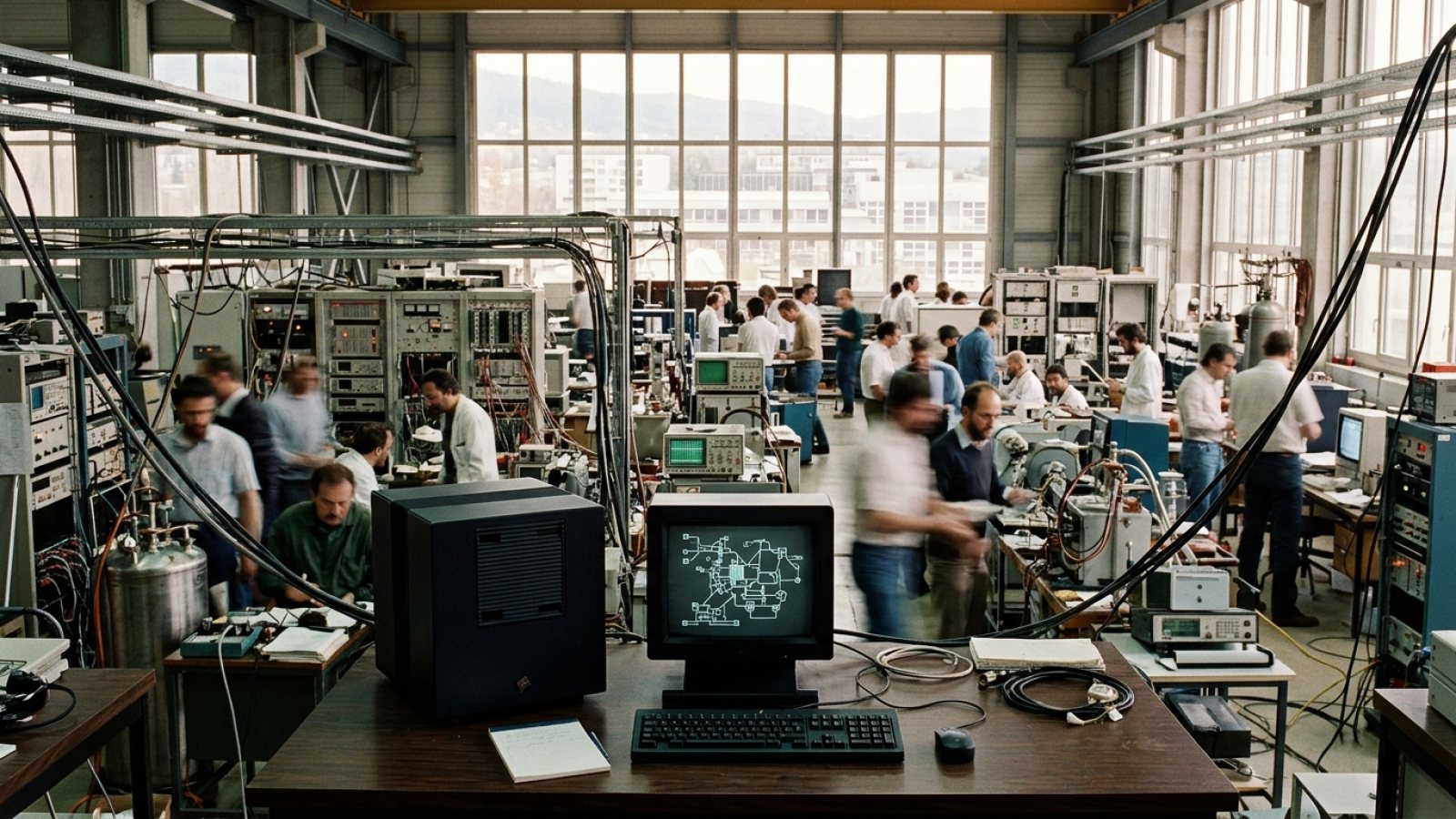
Over the next two years, Berners-Lee, initially working alone and later with collaborator Robert Cailliau, began to build the tools necessary to turn his vision into a working reality. He used a NeXT Cube computer, one of the earliest workstations with an object-oriented operating system, to develop the first web browser and editor, which he also named WorldWideWeb. By October 1990, he had written the fundamental code for the HTTP server (httpd) and the first version of HTML. The first successful communication between a client and server over the internet happened later that year. In December 1990, the first website, http://info.cern.ch/, went live, explaining the project itself and how to access it.
The system was revolutionary in its simplicity and universality. Unlike earlier hypertext systems that were often proprietary or limited to specific operating systems, Berners-Lee's vision was designed for interoperability from the ground up. He defined the core components—URI, HTTP, HTML—as open standards, allowing anyone to create browsers, servers, or content without permission or licensing fees. This decision, formally solidified by CERN in April 1993 to make the core technologies royalty-free, proved pivotal for the web's explosive growth.
A Global Information Revolution
The initial impact within CERN was immediate, allowing researchers to quickly find and share documentation. However, the true transformation began as the web moved beyond the scientific community. The availability of graphical browsers like Mosaic in 1993, developed at the National Center for Supercomputing Applications (NCSA), made the web accessible to a wider audience, introducing a user-friendly interface to Berners-Lee's underlying architecture.
The World Wide Web quickly blossomed into an unprecedented platform for global communication, commerce, and culture. It democratized publishing, enabled new forms of social interaction, and created entirely new industries. From academic research to everyday shopping, from global news dissemination to personal expression, the web reshaped human interaction with information on a scale previously unimaginable. Berners-Lee's seemingly "vague" proposal laid the groundwork for an open, interconnected world, demonstrating the profound power of simple, universal standards when applied to a global network. His work remains a testament to the idea that fundamental innovations often stem from addressing practical problems with elegant, open solutions.
