In the mid-20th century, the landscape of electronics was dominated by the vacuum tube, a fragile glass bulb that used heated filaments to control the flow of electrons in a vacuum. These tubes, while groundbreaking for their ability to amplify radio signals and switch electrical currents, were bulky, consumed significant power, generated considerable heat, and had a limited lifespan. Engineers at Bell Telephone Laboratories, driven by the need for more reliable and efficient components for their vast telephone network, sought a solid-state alternative—a device that could perform similar functions without the inherent drawbacks of a vacuum.
From Vacuum to Solid-State: The Need for Change
The problem presented a formidable challenge: how to achieve amplification and switching in a solid material. Researchers at Bell Labs had been exploring semiconductors—materials like germanium and silicon that conduct electricity under certain conditions, unlike insulators or full conductors. The goal was to manipulate their electrical properties to control current flow. Leading this charge were theoretical physicist John Bardeen, experimental physicist Walter Brattain, and solid-state physicist William Shockley. Their collective work on semiconductor physics would ultimately unlock the door to a new era of technology.
Bardeen's theoretical insights into the behavior of electrons at the surface of semiconductors provided a crucial framework, while Brattain meticulously conducted experiments to test these hypotheses. Their work often involved manipulating minute contacts on the surface of germanium crystals, observing how small electrical changes could influence larger currents. The environment at Bell Labs fostered a culture of deep scientific inquiry and collaboration, providing the resources and freedom necessary for such fundamental research.
The Moment of Amplification: Bell Labs, 1947
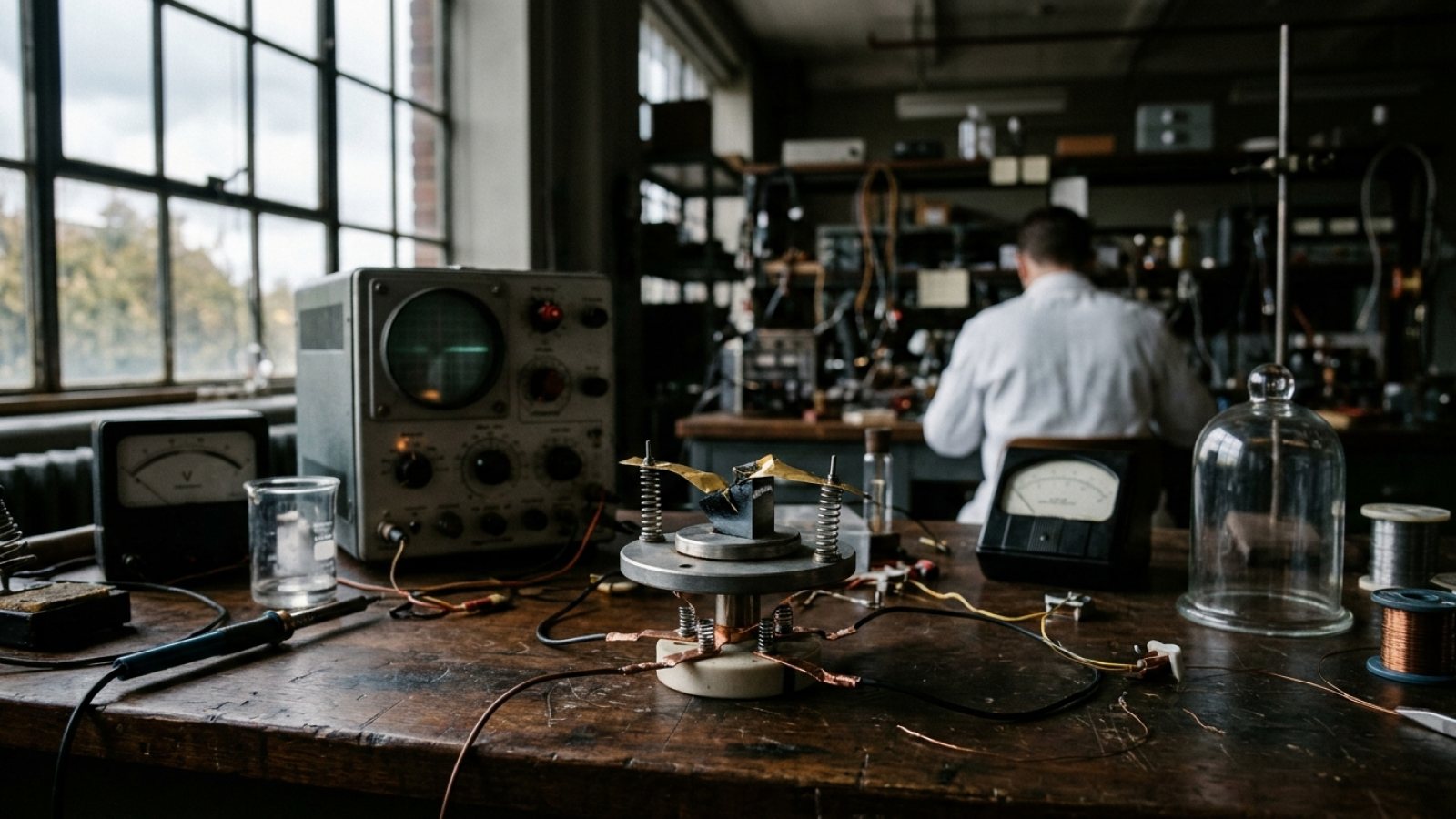
The breakthrough arrived in December 1947 at Bell Labs' Murray Hill, New Jersey facility. On December 16, 1947, after weeks of intensive experimentation, Bardeen and Brattain successfully demonstrated a device that could amplify a voice signal. This first working model, which became known as the point-contact transistor, consisted of a small wedge of germanium with two thin gold foil contacts pressed against its surface, acting as the emitter and collector. A third, larger contact on the base of the germanium served as the base. A small change in current applied to one of the gold contacts could control a much larger current flowing through the germanium, achieving the desired amplification.
The public announcement of this invention came in June 1948, catching the attention of the scientific and engineering worlds. While Bardeen and Brattain had developed the initial point-contact device, William Shockley, who had also been instrumental in the overall research program, independently conceived of a more robust and manufacturable device, the junction transistor. This device, developed shortly after the initial discovery, offered superior performance and was easier to fabricate, becoming the foundation for mass production. For their pioneering research into semiconductors and their discovery of the transistor effect, Bardeen, Brattain, and Shockley were jointly awarded the Nobel Prize in Physics in 1956.
A New Age of Electronics
The implications of the transistor were immediate and profound. Replacing bulky, hot, and unreliable vacuum tubes with tiny, cool, and durable solid-state components enabled a radical shift in electronic design. Transistors required significantly less power, generated minimal heat, and were far more resilient. This combination of attributes meant electronic circuits could be made smaller, more complex, and vastly more reliable.
What started as a solution for improving telephone repeaters soon became the fundamental building block for almost all modern electronics. The transistor's invention paved the way for the integrated circuit, where multiple transistors could be fabricated onto a single silicon chip, leading to microprocessors and memory chips. From the earliest room-sized computers to the smallest handheld devices, from satellite communication to medical equipment, every piece of modern technology relies on the principles discovered at Bell Labs in December 1947. The transistor didn't just replace the vacuum tube; it launched the digital revolution, fundamentally reshaping human society and the world we inhabit.